Multilingual Mindful Productivity App
Led service and recommendation-engine design for a multilingual productivity app that blends task management with mindfulness and creativity exercises, grounded in ethnographic field research, to help users produce better work, not just feel calmer while doing it.
To make quality mental and physical health information more accessible to all demographics, by integrating everyday productivity tools with wellbeing and creativity exercises that drive better work outcomes, not just better feelings.
Business Problem
Access to quality health information is limited to premium services, making proactive self-care and disease prevention hard to sustain. Existing productivity tools and wellness tools are built as separate categories, so users bounce between a task list and a meditation app with no connection between the two. As a result, wellbeing activity rarely translates into better work product.
Approach
Before designing anything, we deliberately chose which pain point to build around. Early discovery surfaced dozens of candidate frustrations, such as app clutter, notification fatigue, and generic content, but these were low-severity: annoying, not disqualifying. We instead honed in on one acute, high-severity pain point felt by a distinct, underserved audience: self-taught and informally-employed knowledge workers who cannot afford unproductive days, yet have no affordable way to manage burnout without it directly costing them income. For this audience, stress isn't a wellbeing issue in the abstract: it is a direct threat to their livelihood, which made it the pain point worth building the entire product thesis around. The core design thesis that followed was integration, not addition: rather than bolting a wellness module onto a to-do list, we designed the product so mindfulness and creativity exercises were surfaced contextually, at the moments they would most improve the task at hand. Examples include a short breathing exercise before a high-stakes task, a divergent-thinking prompt when someone is stuck, and a reflection nudge after a deep-work block. This required designing the underlying recommendation logic itself: defining the signals (task type, time of day, recent completion patterns, self-reported energy/mood, language and locale), the rules and scoring model for ranking which exercise to surface and when, and the feedback loop that let the model learn from whether a recommendation was accepted, dismissed, or led to a completed task. We worked closely with engineering to specify this as a lightweight, explainable rules-plus-scoring system rather than an opaque model, so recommendations stayed auditable and could be tuned by the NGO's own team post-launch. Insights from the field shaped personas, journey maps, and feature prioritisation for the MVP.
Customer, Competitor and Market Research
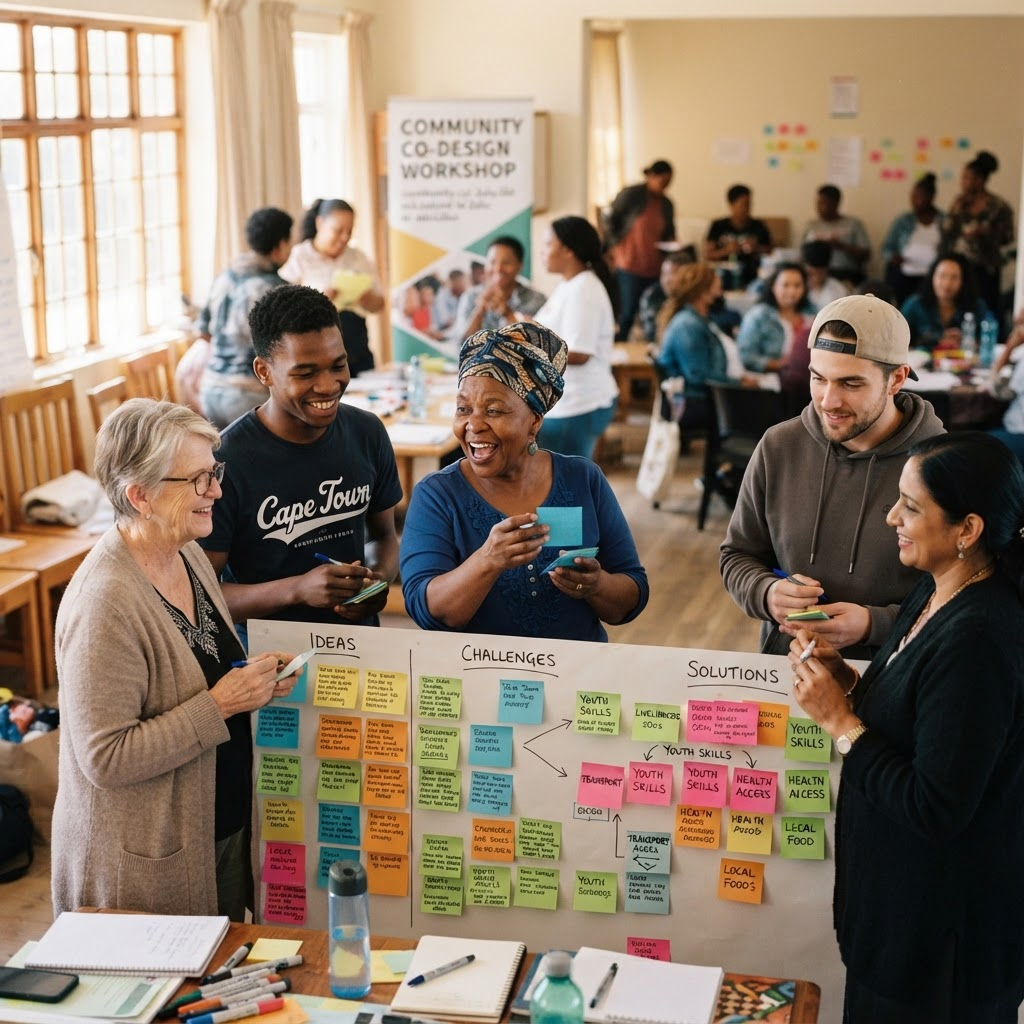
We conducted several rounds of research to comprehend the primary user beliefs, concerns, and journey regarding their experiences with wellness, healthcare, and health media systems. These findings were organised into archetypes and personas, which undergo continuous updates with each round of user testing.
Recommendation Engine Design
Designed the logic behind how the app decides which mindfulness or creativity exercise to recommend, and when. This meant defining the input signals (task category and urgency, time of day, recent app usage patterns, self-reported mood/energy, language), designing a transparent scoring model to rank candidate exercises against the user's current context, and specifying the feedback loop (accept, dismiss, complete) that fed back into future rankings. Worked directly with engineering on the data model and event tracking required to support this, favouring an explainable rules-plus-scoring approach over a black-box model so the NGO's team could interpret and adjust it after handover.
Journey Mapping
A synthesised overview of the primary pain points was presented to the key stakeholders, accompanied by competitor analysis and case studies illustrating wellness and habit-forming best practices. This facilitated the generation of ideas for how productivity and wellbeing moments could be woven together throughout a single day. Utilising the insights gathered from these workshops, we mapped and verified both retail user and business user journeys.
Service Blueprinting
Blueprints were constructed and validated using several virtual blueprint workshops, mapping how the recommendation engine's outputs surfaced across the product experience. A system of archiving was used to maintain the relevant blueprint used for each release cycle. Discussion points were prepared ahead of each blueprint workshop with prioritised critical decisions, and required offline discussions were managed using an engagement group matrix.
Testing, Feedback and Continuous Improvement
We engage volunteer customers and test panels on a frequent basis to user test new features and validate whether recommended exercises were actually improving reported focus and task completion. We regularly meet with NGO stakeholders to playback findings and offer recommendations based on this specific demographic's needs.